


Radium Engineering has extensive experience with automotive fluid connections. This guide explains the most popular fluid connections currently used for plumbing fuel, oil, coolant, and other needs in aftermarket automotive applications. It will also explain methods for assembly to ensure a leak-free installation.
To properly and safely install our products, understanding how fittings work is of the utmost importance. Most of the following information can be found with research. However, we consolidated this in one place.
NOTE: Brake line related fittings such as SAE flare, inverted flare, hard lines/tubing, tapered pipe thread, etc will not be covered in detail. All listed information is simply a general guide. Please consult with hose and fitting manufacturers before selecting components for safety critical systems.
AN STYLE HOSE CONNECTIONS
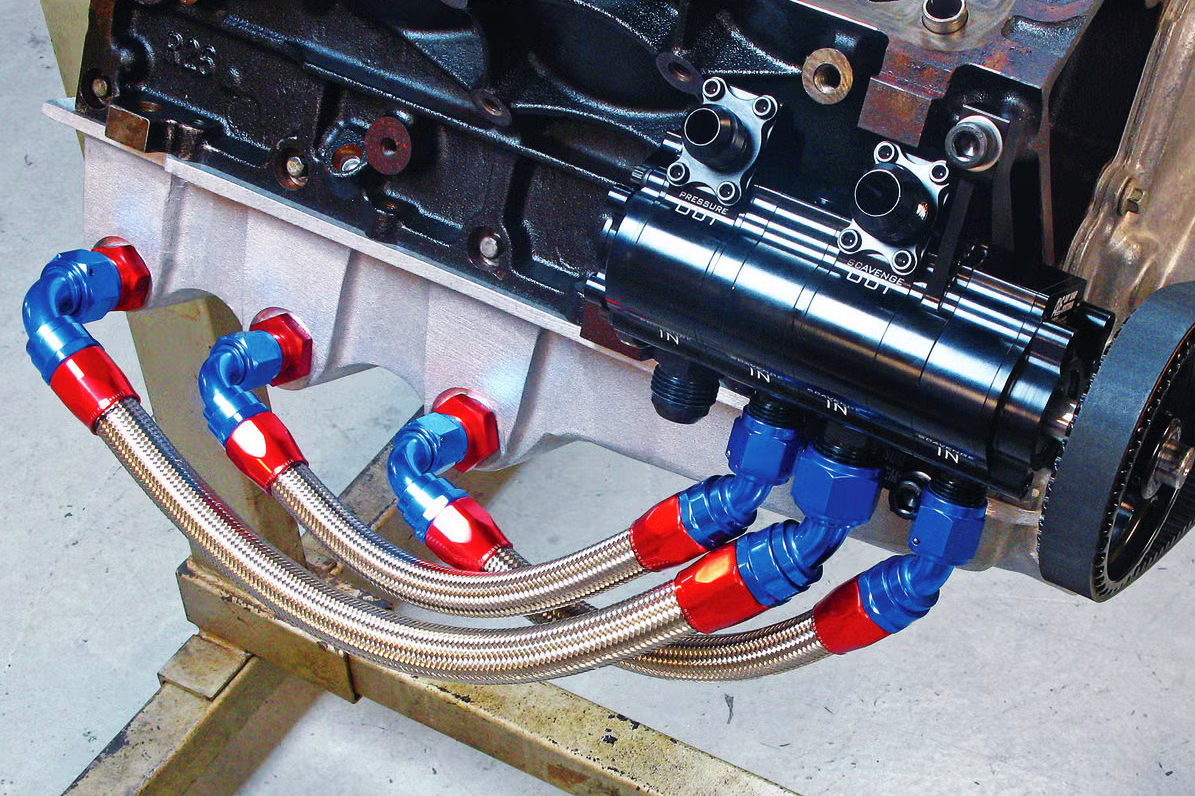
AN (Army/Navy) fittings descend from old military plumbing specifications, and are now used extensively in the automotive aftermarket world. Fittings are most commonly manufactured from aluminum. However, there are some situations that may require high strength steel fittings, such as high pressure brake lines, direct fuel injection, or power steering pressure lines.
Aluminum fittings are sold in a variety colors, most commonly red/blue, black or silver. Color is cosmetic only and does NOT denote anything regarding compatibility. The number field of the AN name (such as 6 or 8) is the number of 16th's of an inch of the inner diameter of the corresponding hose. For example 6AN is 6/16th's of an inch, or 3/8 inch. 8AN is 8/16th's of an inch, or 1/2 inch.
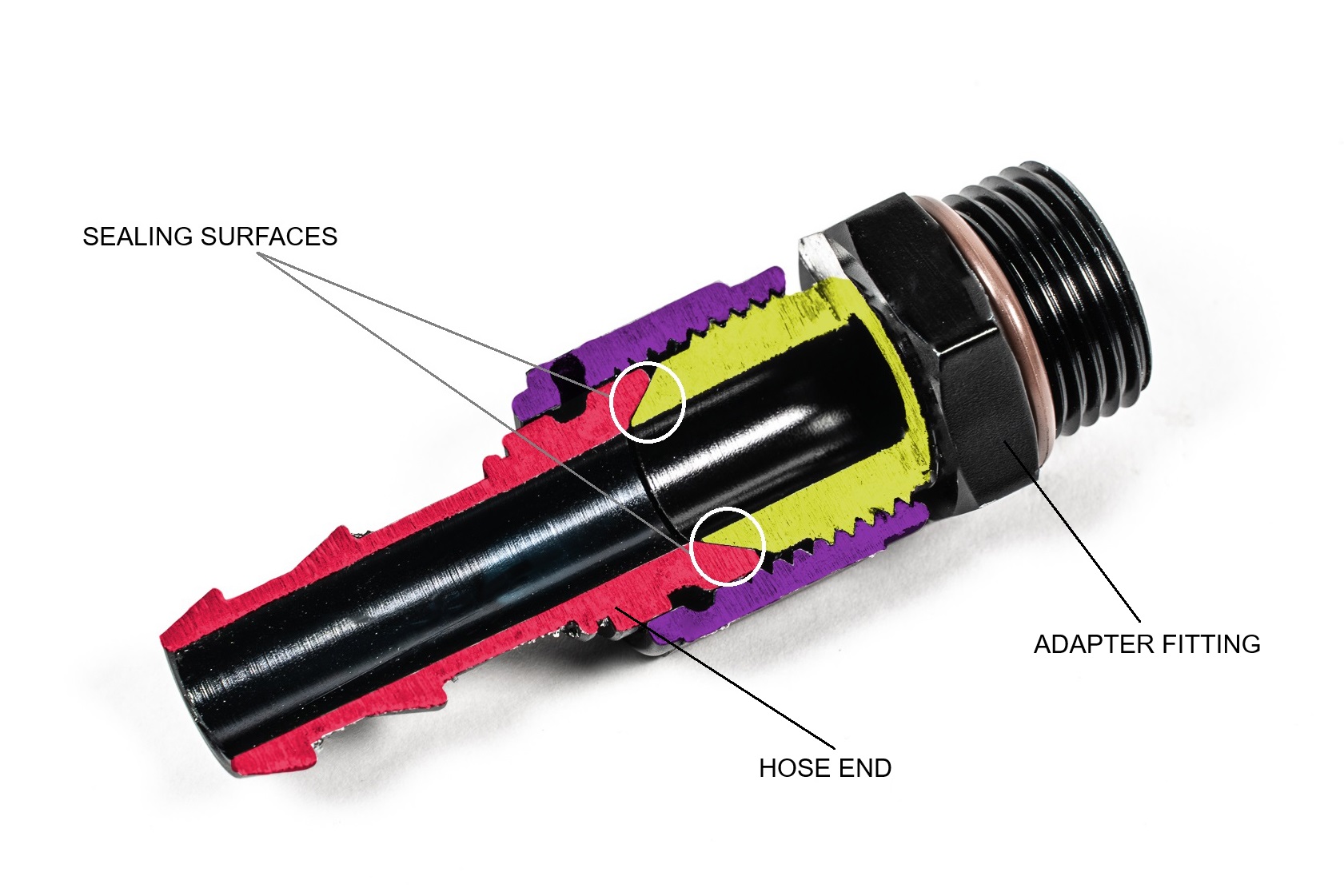
Sealing happen with two 37 degree tapered metal surfaces squeezing together. AN fittings do NOT rely on O-rings, paste, PTFE tape or anything else, just clean metal surfaces compressed together. Application of PTFE, thread sealing paste, or any other foreign material may jeopordize the quality of the sealing surfaces and is not recommended. AN fittings can withstand extremely high pressures and are rarely a source of failure (when assembled correctly). Fittings are reuseable and easily serviced.
Sealing surfaces MUST be free of defects such as nicks, scratches or machining marks. Damage can occur if the AN fitting is over torqued.
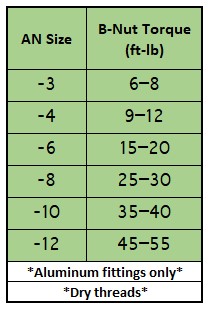
See the table below for recommended torque values when tightening a hose-end onto a male AN fitting. If a torque wrench is not availble, 1/8 to 1/4 turn past finger tight is typical.
The diagram below shows a section view of a hose end (red) connected to an adapter fitting (yellow). When the B-nut (purple) of the hose end is tightened, it compresses the tapered sealing surfaces together to form a perfect seal. Notice how the fluid flow diameter remains constant through the connection.
In the industrial/hydraulic industry, these AN fittings are called JIC (Joint Industry Council). JIC is compatible with AN, as they use the same overall geometry. JIC fittings are commonly made of zinc-plated steel and are designed for over 1000psi of pressure found in hydraulic systems. These are generally not used on automotive performance applications due to the racing industry's preference for lightweight aluminum fittings.
AN sizing is calculated based on the internal diameter of the hose. For compatibility, 2 fittings must have the same AN size.
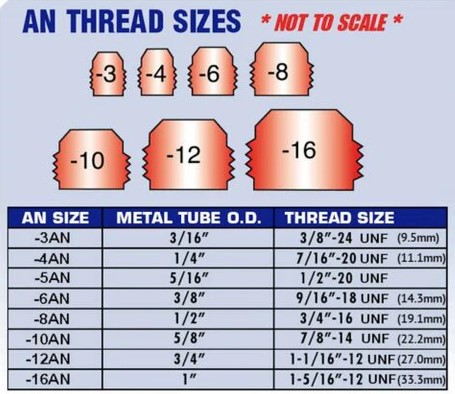
Fitting sizes, such as 6AN, are pronounced "dash 6" or "6 A N". Using this terminology can reduce confusion with vendors and manufacturers. These are also sometimes called "AN flare fittings".
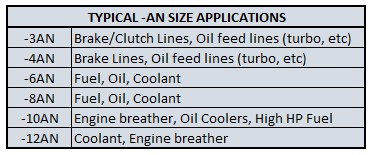
The chart below gives some typical applications for common AN sizes. There are exceptions to all of them, so consult with component manufacturers for recommended hose sizing.
ORB CONNECTIONS
ORB stands for "O-Ring Boss" and describes a female threaded port designed for fittings with an O-ring. Radium Engineering uses ORB ports extensively, as they offer a reliable and easily servicable sealed connection. ORB ports can be found in all Radium Engineering fuel rails, oil catch cans, fuel pump hangers, and more.
ORB ports are sized with the same nomenclature as AN fittings (above) and they also use the same thread size/types as AN fittings. This means that a 8AN male fitting will thread into a female 8AN ORB port. However, an O-ring must be used to achieve a proper seal.
CLICK HERE FOR ORB ADAPTER FITTINGS
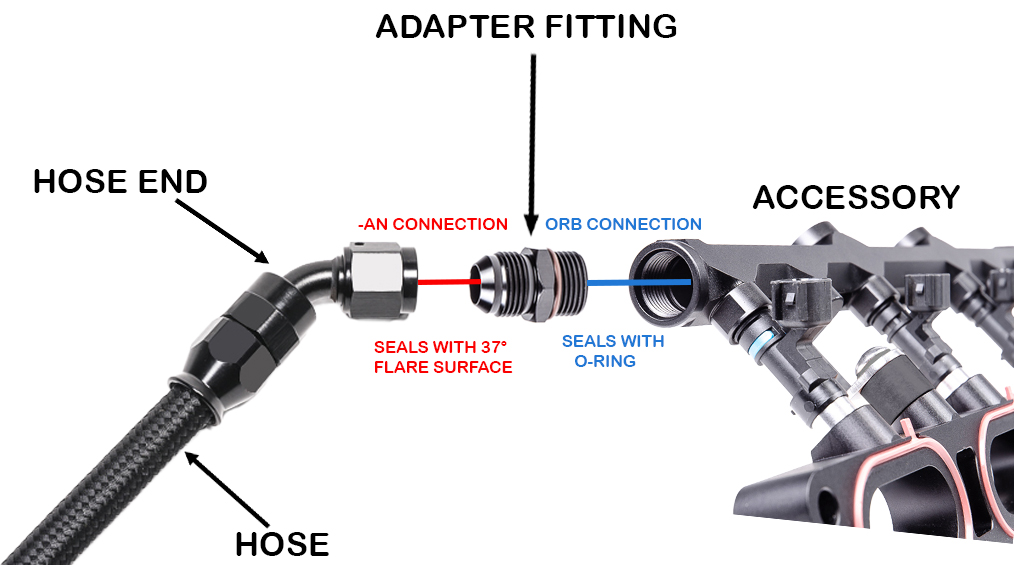
As shown below, adapter fittings are used to bridge the connection between a hose end and a female ORB port. NOTE: For proper installation of ORB fittings, the O-ring must be lubricated with oil and the fitting fully tightened. Replacement O-rings can be purchased directly from Radium Engineering if needed.
TAPERED PIPE THREAD (NPT)
Radium Engineering avoids the use of NPT (or BSPT) threaded connections as much as possible as they have shown to be unreliable and are the most common source of leaks. NPT connections do not seal using an O-ring or a smooth flared hard surface. Instead, the mating threads mesh together to form a seal, permanently deforming the threads. For proper sealing, these fittings require PTFE to be applied to the male threads. This not only helps seal the connection, it also lubricates the threads for a tighter fit.
NPT fittings are most prone to installation errors due to over or under torquing. When installing NPT fittings, the industry standard is to hand tighten first. Then add 1.5-3 turns with a wrench.
HOSE TYPES
The automotive aftermarket is flooded with a wide variety of hoses made from different materials. It is important to select the correct hose for the application. This section will focus on the types of hose offered by Radium Engineering.
RUBBER HOSES
Radium Engineering offers a few types of hoses that are of rubber construction; PCV hose, EFI hose, submersible hose, heater hose and vacuum hose. These are effective and affordable for automotive plumbing. They are easy to work with and can be cut with a standard razor knife.
Heater hose is designed for continued high temperature operation of propylene glycol (antifreeze) and water.
Vacuum hose is designed to prevent hose collapsing in high vacuum situations and is available only in small diameters.
Submersible hose is designed to be submerged in fuels, such as gasoline, E85, etc. Not all fuel line is able to be fully submerged!
Radium reinforced PCV hose is designed for crankcase gasses and fluids such as oil, fuel, and water. It can also withstand high pressure (boost) and low pressure (vacuum).
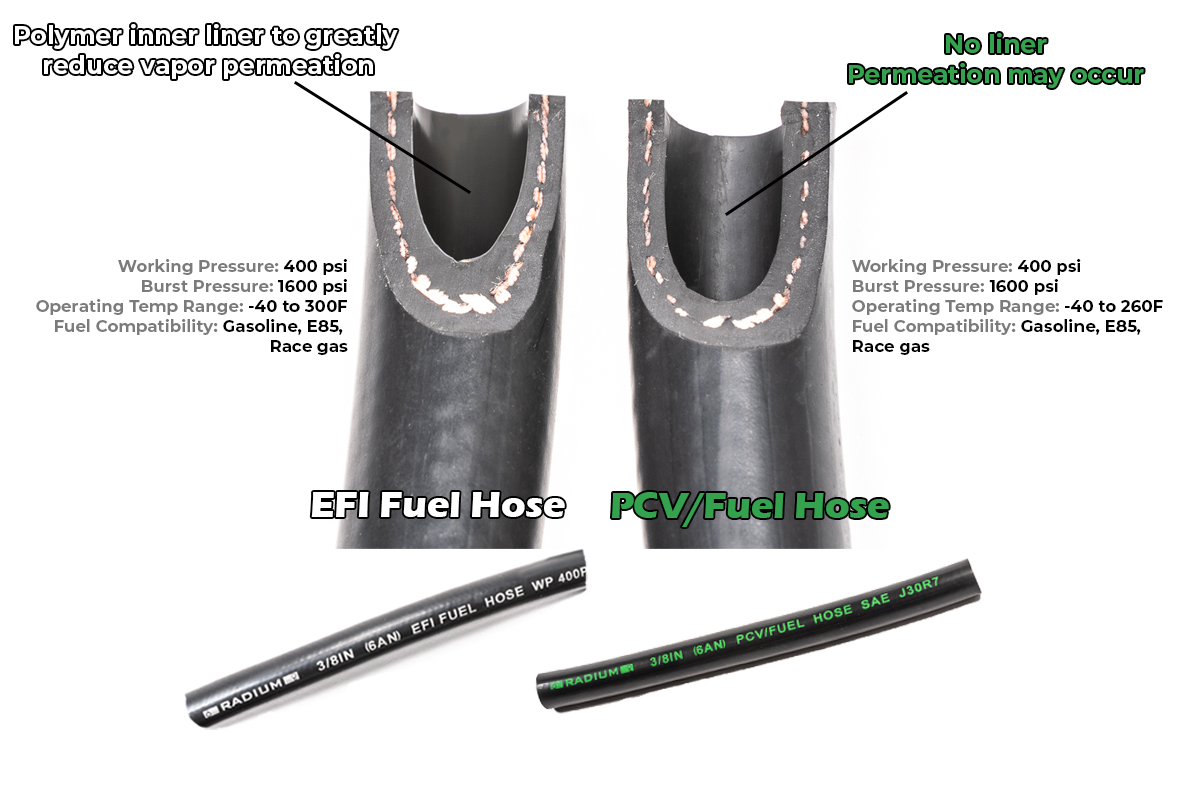
Radium EFI hose is similar to the PCV hose, but features an added internal layer that helps prevent fuel vapors from permeating through the hose walls. This reduces the chance of fuel odor, sometimes noticeable when a vehicle is stored in an enclosed enviornment.
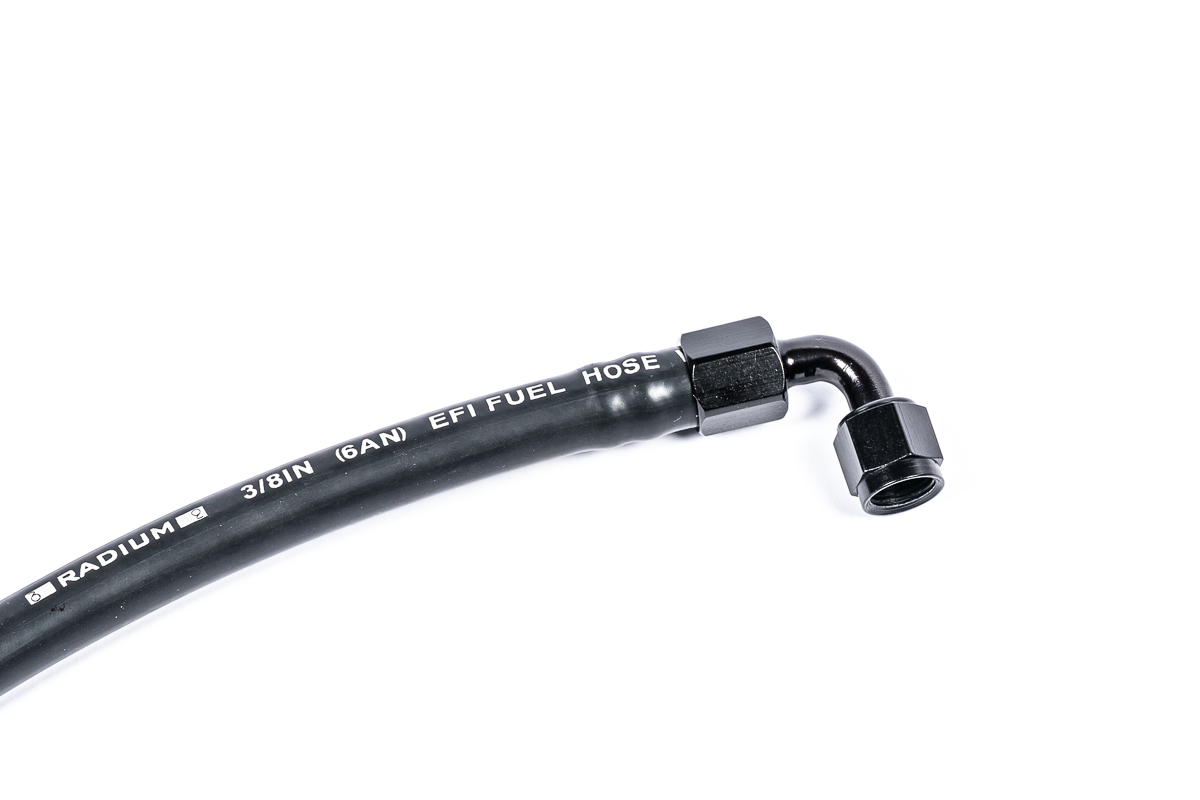
PCV and EFI hose are compatible with pushlok-style hose ends, shown below. This type of hose assembly has been burst tested to over 800psi.
CLICK HERE FOR PUSHLOCK HOSE-ENDS
PTFE HOSES
The other family of hoses that Radium Engineering offers are PTFE. These hoses utilize a PTFE core reinforced with a stainless steel wire braid and finished with a black woven fabric braid or other type of protective layer. These hoses have excellent chemical compatibility and can withstand very high pressures. They do not allow any vapor permeation. They are the top choice when failure is not an option.
Downsides with PTFE: Reduced flexibility, increased cost, assembling hose ends, special cutting tools required.
These must be assembled with hose ends that are specifically designed for PTFE.
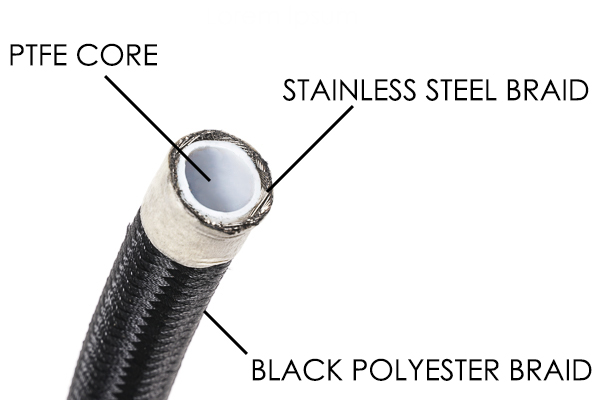
PTFE hoses can be constructed using crimped or screw-together hose ends. Special hydraulic machinery is required for crimp-style hose ends. 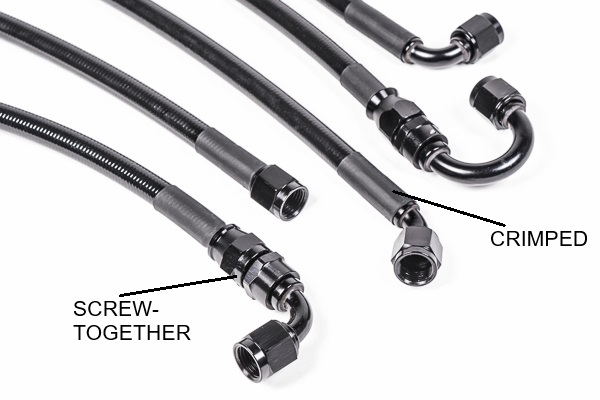
CLICK HERE FOR UNIVERSAL PTFE HOSE KITS
CLICK HERE FOR PRE-ASSEMBLED PTFE HOSES
Other types of hoses and fluid connections exist in the marketplace, and within these segments new products are continuously being released. So not every type of connection is discussed in this article. However, the information here should help build a successful system with Radium Engineering products.